Logout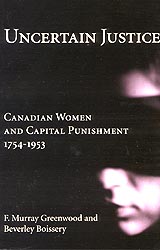
Uncertain Justice: Canadian Women and Capital Punishment 1754-1953
 2000
2000 
by F. Murray Greenwood, Emeritus Professor of History, University of British Columbia and Beverley Boissery, Independant Scholar. Published with Dundurn Press, 2000.
In recent years, scholars in all disciplines, feminists and traditionalists, have increasingly recognized how significant issues of gender are in understanding most aspects of the human condition. Indeed gender as a category of analysis has assumed a place at least as central as class and race in the very best historical work. In Uncertain Justice, the husband and wife author team of Beverley Boissery and Murray Greenwood apply gender analysis to the study of the trial and execution of female criminals in colonial and modern Canada. Through eight major case studies and many minor ones Uncertain Justice reveals the evolution of this aspect of capital punishment across the course of Canadian history. An analytical introduction and conclusion bracket the case studies and together with two thematic chapters engage critical general issues. Most notably these include the execution of those who may have been innocent, the long exclusion of women from criminal juries, the emergence of the “battered woman syndrome,” and jury nullification of many laws, including infanticide and abortion. Two themes which loom particularly large are the use of paternalistic ‘sham chivalry’ to protect individual women at the expense of stereotyping them generally as weak-minded, and the relentlessly political nature of much of the criminal law process, particularly with regard to the exercise of mercy. Uncertain Justice is an engagingly written book which offers numerous insights into one of the darker sides of Canadian criminal
Related Topics
Contents
Table of Contents
Foreword 9
Acknowledgments 11
Introduction 13
Chapter One: The Eleanor Power Story 23
Chapter Two: The Many Trials of Marie-Josephte Corriveau 39
Chapter Three: “Beauty, Thou Pretty Plaything!”:
Margaret Jordan — Murderer? Pirate? 61
Chapter Four: Julia Murdock — From “Comparative Innocence
to … Blackest Guilt”? 81
Chapter Five: The Capital Conviction of Innocent Persons 99
Chapter Six: “Sham Chivalry”: Canadian Women and the
Criminal Jury in Capital Cases, 1867-1962 123
Chapter Seven: Elizabeth Workman — Sinner or Saint? 141
Chapter Eight: Annie Robinson — “More to be Pitied 161
Than Censured”? 161
Chapter Nine: Jennie Hawkes — A Woman Wronged 181
Chapter Ten: Annie Rubletz and Mary Paulette —
“The Far Side of Despair” 197
Conclusion 217
Endnotes 231
Bibliography 269
Selected Index 281
Reviews
Uncertain Justice serves to indirectly endorse the importance of contemporary fundamental principles of justice and the reality of gender differences in Canadian society...the book is an interesting read. Donna Turko, Advocate (Vancouver Bar Association), Vol 59, 2001, p. 951.
Chris Raible, Ontario History, Vol 93, 2001, p. 203.
William A. Schabas, Canadian Journal of Criminology and Criminal Justice, available online here.
Margaret Kechnie, Canadian Book Review Annual, 2000, p. 362.