Logout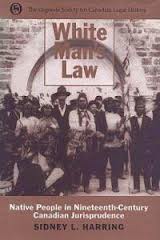
White Man’s Law: Native People in Nineteenth-Century Canadian Jurisprudence
 1998
1998 
by Sidney Harring. Published with the University of Toronto Press, 1998.
In recent years numerous important books have appeared which deal with the history of aboriginal populations in early Canada. Although these studies add enormously to our understanding of the role played by native peoples in the British North American and Canadian communities, there has been to date no significant study of the dynamic and at times tragic relationship between Euro-Canadian law and the legal traditions of aboriginal populations. Professor Sidney L. Harring now addresses that lacuna in this sweeping re-investigation of Canadian legal history. In the nineteenth century, many Canadians commented proudly on what they regarded as this country’s liberal treatment of Indians. In challenging that conception, Professor Harring draws on scores of nineteenth-century legal cases. His study demonstrates that colonial and early Canadian judges were sublimely ignorant of British policy concerning Indians and their lands and arrogantly indifferent to native rights and traditions. A great strength of the study is its account of the remarkable tenacity of First Nations in continuing their own legal traditions despite obstruction by the settler society that came to dominate them. Today legal decisions respecting native rights and land claims reverberate throughout our society, affecting the rights and obligations of all Canadians. This study helps us to understand and come to terms with how we arrived at our present condition. It leaves no doubt that Canadian native legal culture requires further study by scholars and that aboriginal history demands more serious attention by courts in rendering decisions.
Related Topics
Contents
Contents
FOREWORD ix
ACKNOWLEDGMENTS xi
Introduction 3
1 ‘The Privilege of British Justice’: Colonialism and Native
Rights 16
2 ‘A Condescension Lost on Those People’: The Six Nations’
Grand River Lands, 1784-1860 35
3 ‘The Common Law Is Not Part Savage and Part Civilized’:
Chief Justice John Beverley Robinson and Native Rights 62
4 ‘The Migration of These Simple People from Equity to Law’:
Native Rights in Ontario Courts 91
5 ‘Entirely Independent in Their Villages’: Criminal Law andIndians in Upper Canada 109
6 ‘A More Than Usually Degraded Indian Type’: St. Catherine’s
Milling and Indian Title Cases 125
7 ‘Canadian Courts Are Open to Enforce Their Contracts’:
Canadian Law and the Legal Culture of Ontario Indians 148
8 ‘The Indians Are a Perseverant Race’: Indian Law in Quebec
and Atlantic Canada 165
9 ‘Can We Be Free under the Law of Queen Victoria on Top of
Our Land?’: Indians and the Law in British Columbia 186
10 ‘The Enforcement of the Extreme Penalty’: Canadian Law and
the Ojibwa-Cree Spirit World 217
11 ‘No Recognized Law’: Canadian Law and the Prairie Indians 239
Conclusion 273
NOTES 283
ILLUSTRATION CREDITS 411
INDEX 413
Awards
- Finalist-Donner Prize for the best book on Canadian public policy (1998)
Reviews
Harring has written a powerful ... legal history that gives due attention not only to the intent and actual impact of western law on aboriginal lives and resources and rights but also pays attention to aboriginal law itself.....This is an outstanding legal history of a complex and nuanced subject matter. Anyone interested in the historical and legal rights of Canada's aboriginal people or that state's avowed and actual Indian policy and jurisprudence should study it carefully. David Wilkins, Law and History Review, vol 35, 2002
White Man's Law effectively localizes Canadian legal history. It addresses conflicts with a keen awareness of specific context. This text is provocative and impressive in that it does not attempt to homogenize or essentialize the place of First Nations in the various legal contests that it addresses. Desiree Lundstrom, Canadian Literature, Autumn 2002
Paul Burrows, Zcommunications, April 2011, click here to read
Tracey Lindberg, Labour/Le Travail, Issue 47, Spring 2001, p. 185
Marvin R.V. Storrow and Kelly Keenan, Advocate (Van.), Vol 58, 2000, pp. 282-284
Mark D. Walters, Queen’s Law Journal, Vol 25, 2000, pp. 719-724
Douglas C. Harris, Canadian Historical Review, Vol 81, 2000, pp. 305-307
Kathryn Arbuckle, Canadian Law Libraries, Vol 24, 1999, p. 216
Brian Gobbett, Alberta Law Review, Vol 37, 1999, pp. 1094-1096
Douglas Fisher, ‘Weighty topics; heavy reading,’ Toronto Star