Logout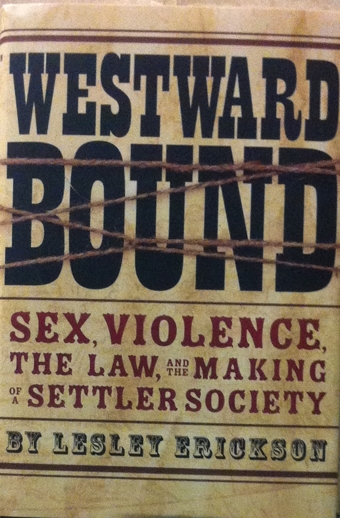
Westward Bound: Sex, Violence, the Law, and the Making of a Settler Society
 2011
2011 
by Lesley Erickson, Independent Historian and Researcher, Vancouver. Published with UBC Press, 2011.
The history of crime and punishment is one of the principal lenses through which historians of the law investigate the relationship between the law in the books and the ‘law in action,’ and the uses of law to regulate relations among social groups. Professor Lesley Erickson’s account of the operation of the criminal law in the prairie west in the late nineteenth and first half of the twentieth centuries performs both tasks admirably. Using local court records and a rich variety of other sources, Erickson examines the use of the law on reserves, in the cities, and in the countryside, from high profile cases to day-to-day policing and punishment practices. This is an invaluable addition to the Osgoode Society’s socio-legal history collection, and we are very pleased to publish the first of what we are sure will be many books by Professor Erickson.
Related Topics
Contents
Contents
List of Figures and Tables / ix
Foreword / xi
Acknowledgments / xiii
Introduction / 1
- Fruitful Land, Happy Homes, Manly Titans: Settlement Frontiers, Law, and the Intimate in Colonialism and Nation Building / 16
- They Know No Better: Maintaining Race and Managing Domestic pace at the Fringes of Civilization / 44
- The Most Public of Private Women: Prostitutes, Reformers, and Police Courts / 78
- The Farmer, the Pioneer Woman, and the Hired Hand: Sexual Violence, Seduction, and the Boundaries of Class / II5
- For Family, Nation, and Empire: Policing Drugs, Abortion, and Heterosexuality in the Interwar City / 142
- The Might of a Good Strong Hand: Domestic Violence, Wife Murder, and Incest / 174
- She Is to Be Pitied, Not Punished: The Murderess, the Woman
Question, and the Capital Punishment Debate / 201
Conclusion / 229
Notes / 239
Bibliography / 292
Index / 321
Figures and Tables
FIGURES
- Judicial districts: Manitoba and North-West Territories, 1889-1907 / 5
- Map of selected judicial districts, 1917 / 5
- Images of domestic life: The pioneer family, 1931 / 23
- “The Right Land for the Right Man” / 27
- Canadian Pacific Railway poster, c. 1920 / 28
- Henri Julien, “Sitting Bull on Dominion Territory” / 30
- “Turning Out Prisoners for Work” / 31
- Henri Julien, “The Criminals’ Millennium” / 32
- Law courts, Kennedy Street, Winnipeg, c. 1910 / 34
- First Supreme Court Judiciary of the North-West Territories / 49
- Map of the Kainai Reserve / 61
- Prairie prostitute, 1919 / 80
- “The Door Steadily Opens,” Grain Grower’s Guide, 1910 / 92
- Emily Murphy, Edmonton Police Court / 98
- Amy Warwick, acquitted of murder, 1913 / 206
- The Warwick trial, Regina Morning Leader / 207
TABLES
- Female offenders and the superior courts, 1886-1940 / 100
- Female offenders, superior and police courts, Edmonton, 1892-1939 / 100
- Female offenders, reported summary offences, Winnipeg Police Court / 101
- Types of crimes as percentage of total female offences, Winnipeg Police Court / 102
- Ratio of female to male arrests for inmates and keepers of bawdy houses, Winnipeg Police Court / 103
- Sex crimes as a percentage of total charges, 1886-1940 / 119
- Conviction patterns, sex crime prosecutions: Agricultural labourers vs. farmers / 125
- Sex crime prosecutions, urban centres, 1886-1940 / 161
- Domestic abuse and neglect cases, Winnipeg Police Court / 182
- Prosecution and sentencing patterns, domestic violence, Winnipeg Police Court / 183
- Outcome of child murder or concealment of birth cases, 1896-1940 / 209
- Outcome of murder trials involving convicted female offenders, 1886-1940 / 214
Awards
- Honorable Mention - Canadian Law and Society Association Book Prize (2011)
Reviews
Lesley Erickson … debunks the myth of Canada’s peaceful west…. In a series of thematic chapters Erickson explores conflict between men and women, Native and newcomer, and capital and labour. Lori Chambers, Acadiensis, Vol 41, 2012, p. 252.
Westward Bound is a work of remarkable scope and depth. Covering the period from 1886 to 1940, Lesley Erickson uses records from local courts, the Department of Indian Affairs, and the North West Mounted Police to explore how the law functioned to shore up the Anglo-Canadian settler society of the Prairie provinces. Admirably, Erickson does not tell a simple story of top-down legal authority creating a particular colonial order. Instead, she details how various subordinated groups (women, Aboriginals, eastern European immigrants, prostitutes, and farm labourers, among others) contested, resisted, and manipulated Anglo-Canadian assumptions of superiority. The result is a complex and nuanced picture of the meanings and repercussions of sex and violence in the Canadian west. Chris Hebert, BC Studies, No 177, 2013.
Westward Bound makes an important contribution to our understanding of how the law, crime, and society interacted in Canada's three Prairie provinces ... Westward Bound uses criminal cases as a lens through which to view four social settings in prairie society: the reserve; the city; the countryside; and the home. Michael Boudreau, Law and Politics Book Review, Vol 23, 2013, pp. 476-478
Jean Barman, Western Historical Quarterly, Vol. 44, 2013
Robert Dykstra, Pacific Historical Review, Vol. 82, 2013
Laura Ishiguro, Australasian Journal of Victorian Studies , Vol 18, 2013
William Katerberg, Great Plains Quarterly, Vol 32, 2012, p. 235.
Reference and Research Book News, Vol 26, 2011.
Gilles Renaud, Provincial Judges Journal, Vol. 36, 2014, p. 58.