Logout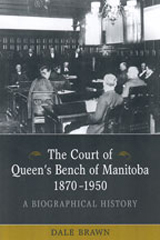
The Court of Queen’s Bench of Manitoba 1870-1950: A Biographical History
 2006
2006 
by Dale Brawn, Professor, Department of Law & Justice, Laurentian University. Published wth the University of Toronto Press, 2006.
This study of the Manitoba judiciary is the first complete biographical history of a provincial bench. The relative youth of Manitoba and the small size of its legal profession makes possible an exceptionally detailed investigation of the background of those appointed to the province’s highest trial court – the Court of Queen’s Bench. This book shows the close connections in the early days between the Ontario bar and the judges of the new province, and highlights the political nature of the judicial appointment process, especially in the period prior to 1950. But it also suggests that in addition to politics and legal ability, many lawyers became judges because they more than others had made themselves known in the communities in which they practised. These biographies of the first thirty-three men appointed to the Court of Queen’s Bench highlight the extent to which the members of the legal elite shared remarkably similar views and ways of thinking. The collective biography approach also allows a remarkably intimate look at personalities ranging from prime ministers to senior government officials to members of the practising bar.
Contents
Contents
Foreword ix
Acknowledgments xi
Introduction 3
1. The Red River Settlement Becomes a Province, 1872 21
Alexander Morris
2. A Time of Controversy, 1872-1878 47
James Charles McKeagney 51
Louis Betournay 66
Edmund Burke Wood 71
3. The End of an Era, 1879-1884 92
Joseph Dubuc 94
James Andrews Miller 113
Lewis Wallbridge 122
Thomas Wardlaw Taylor 128
Robert Smith 140
4. The Manitoba Bar Comes of Age, 1885-1907 149
Albert Clements Killam 154
John Farqhuar Bain 166
Albert Elswood Richards 172
William Edgerton Perdue 175
Thomas Graham Mathers 185
Daniel Alexander Macdonald 199
5. The Emergence of a Provincial Elite, 1908-1920 204
John Donald Cameron 207
Thomas Llewellyn Metcalfe 215
James Emile Pierre Prendergast 223
Hugh Amos Robson 232
Alexander Casimir Galt 246
John Philpot Curran 259
6. A Time of Transition, 1921-1938 266
Andrew Knox Dysart 268
John Evans Adamson 276
James Frederick Kilgour 287
William James Donovan 291
Percival John Montague 296
Fawcett Gowler Taylor 301
Ewen Alexander McPherson 305
7. A Most Political Bench, 1939-1950 311
William James Major 312
Esten Kenneth Williams 319
Arnold Munroe Campbell 342
Joseph Thomas Beaubien 346
John Joseph Kelly 350
Conclusion 352
Appendices 363
Notes 369
BIBLIOGRAPHIES
Introduction and Conclusion 423
Biographical 426
Index 495
Reviews
[This book] offers opportunities to reflect on the creation of a distinct ... Canadian law..... Manitoba is particularly well-suited to such a study ....Brawn uses the biographies [of the judges] to place judges within their historical context.... As Brawn makes clear, ... judges have ... played central roles in Manitoban and Canadian political history. James Muir, Alberta Law Review, vol 45, 2007.
His research has been prodigious...the result is a full and fascinating history. Through the lives of the judges, we realize how early Manitoba was seen as the frontier of opportunity, beckoning young lawyers from the East... The biographies are full and candid...supplemented by an informative introduction and other notes that, together, form the best available short introduction to the history of the court... A valuable new addition to the short shelf of works on Manitoba's legal history. Trevor D. Anderson. Headnotes and Footnotes: The Manitoba Bar Association Newsletter, Vol. 37, No. 10, December 2006
Brawn's story is not simply about the Manitoba bench and bar, but about the making of law and order in a country moving from a frontier to a modern, urban society.... Brawn's biographical sketches are entertaining as well as offering interesting glimpses into the making of Canadian law and the legal community...Brawn will introduce you to some good stories, open up Canada's legal past and perhaps even having you questioning the justness of the legal system built here. James Muir, The National Post, Wednesday, Dec. 20, 2006.
Justice Gilles Renuad, High Court Quarterly Review, vol 5, 2009