Logout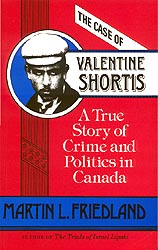
The Case of Valentine Shortis: A True Story of Crime and Politics in Canada
 1986
1986 
by Martin Friedland, Emeritus Professor Law, University of Toronto. Published with the University of Toronto Press. 1986.
Since its inception, the Osgoode Society has been anxious to publish scholarly studies of significant Canadian trials. In popular literature this genre, presented in the form of courtroom confrontations, appeals to the imagination and reaches a wide audience. A more serious presentation need lose nothing of this sense of drama, and it offers as well the opportunity to explain and analyse important legal issues in an often compelling fashion.Professor Martin L. Friedland, one of Canada’s leading legal scholars and a member of the Osgoode Society’s Board of Directors, achieves this objective and much more in his study of the case of Valentine Shortis. The Shortis affair impacted negatively on the dying federal Conservative government of the 1890s and was a landmark, equalled only by the Riel trial of the 1880’s, in the evolution of the insanity defence in Canadian murder trials. Professor Friedland’s study vividly brings the case back to life and demonstrates many of the vagaries of the trial and appeal processes and of the Canadian correctional system.
Contents
Contents
PREFACE ix
1
Tragedy at Valleyfield 3
2
Pre-trial Manoeuvres 17
3
The Crown’s Case 31
4
The Defence 47
5
The Psychiatrists 59
6
Rebuttal 75
7
Towards the Verdict 89
8
After the Trial 119
9
December 1895 133
10
Cabinet Meetings 147
11
Repercussions 165
12
Political Turmoil 175
13
The Election of 1896 189
14
On the Banks of the Rivière-des-Prairies 201
15
On Portsmouth Bay 219
16
On the Speed River 239
17
On Georgian Bay 261
18
A Stranger in a Strange Land 281
NOTES 295
INDEX 317
Reviews
His account is fascinating. By focusing on an historical footnote, he has shed new light on an important chapter of legal and political history. Catherine Kentridge, Maclean’s, vol 99, No 48, 1986, p. S3.
A book full of wonders. Donald Akenson, Canadian Historical Review, vol 68, 1987, p. 622.
Overall, Friedland does a good job in exploring significant legal byways and thus enriching our knowledge of government as the country struggled for self consciousness. A.K. McDougall, Canadian Journal of Political Science, vol 21, 1988, p. 617.
Ramsay Cook, Revue d’histoire de l’Amerique française, Vol 41, 1988, p. 434.
John P.S. McLaren, University of British Columbia Law Review, Vol 22, 1988, p. 413.
J.L. Granatstein, American Historical Review, Vol 92, 1987, p. 1306.
Jane Foraker-Thompson, American Review of Canadian Studies, Vol 17, 1987, p. 357.
William Kaplan, Ottawa Law Review, Vol 19, 1987, p. 255.
Graham Parker, Canadian Journal of Law and Society, Vol 2, 1987, p. 187.
Elaine Balpataky, CM: Canadian Materials for Schools and Libraries, Vol 15, 1987, p. 69.
James R. Dubro, Books in Canada, Vol 16, 1987, p. 23.
John Holtby, Canadian Parliamentary Review, Vol 10, 1987, p. 21.
Thomas Woods, The Vancouver Sun, 24 January 1987, p. E4.
Frank Jones, The Toronto Star, 12 October 1986, p. A21.
Gerald J. Stortz, Canadian Book Review Annual, 1986, p. 194.
Kenneth C. Binks, The Ottawa Citizen, 8 November 1986, p. C2.
Peggy Curran, The Gazette (Montreal), 25 October 1985, p. B7.