Logout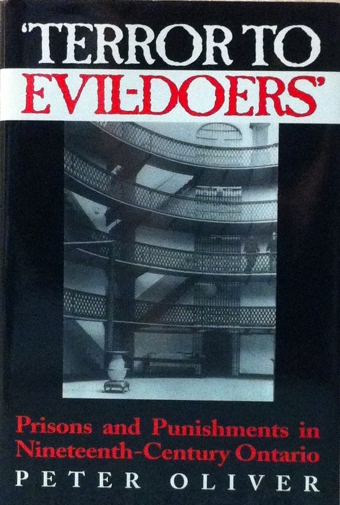
‘Terror to Evil-Doers’: Prisons and Punishments in Nineteenth-Century Ontario
 1998
1998 
by Peter Oliver, Professor of History, York University. Published with the University of Toronto Press, 1998.
We are delighted that Peter Oliver has agreed to include his seminal work on prisons and punishments in nineteenth century Ontario in the Osgoode Society’s Publications Series. Professor Oliver’s book draws on a huge range of previously unexplored primary sources to offer a narrative and interpretive account of the origins and early development of Ontario’s penal system. It should be emphasized that this study was undertaken quite independently of the Osgoode Society, of which Professor Oliver is editor-in-chief, and publication was already in progress through the University of Toronto Press before the Society’s directors requested that “Terror to Evil-Doers” become a Society publication.“Terror to Evil-Doers” is the first Society publication to deal in an extended fashion with the theme of prisons and punishments. Its focus is on the purposes and internal management of Ontario’s gaols, intermediate prisons and penitentiary. By synthesizing a wealth of new material into a comprehensive framework, this important book lays the groundwork for future students and scholars of Canadian history, criminology and sociology.
Related Topics
Contents
Contents
LIST OF TABLES ix
FOREWORD xii
ACKNOWLEDGMENTS xv
INTRODUCTION xix
MAP xxvii
Part I: Colonial Origins
1 Upper Canadian Punishments 3
2 The Gaol and the Community 43
3 ‘Order Is Heaven’s First Law’: The Tory Origins of
Upper Canada’s Penitentiary 86
Part II: In the Penitentiary
4 ‘The Reformation of Convicts Is Unknown’:
The Penitentiary under Henry Smith, 1834-1848 139
5 New Beginnings: The Penitentiary in the 1850s 194
6 ‘Moral Monsters,’ Refractory Females, Children,
and Workers 231
7 Disciplinary Advances 257
8 Institutional Rigidities and Punitive Policies:
The Penitentiary’s Enduring Reality 281
Part III: Alternative Sanctions and Reform Initiatives
9 ‘The Government Boarding House’: Upper Canada’s
Gaols in the Age of Progress 319
10 The Persistence of Community: Ontario’s Gaols in the
Industrial Era 355
11 Terrorizing the Underclass: The Intermediate Prisons 399
12 Aftercare and the Ambiguities of Reform 464
CONCLUSION 500
NOTES 507
INDEX 563
Publications of The Osgoode Society 576
Awards
- Winner -Ontario Historical Society's J.J. Talman Award (2000)
Reviews
This book makes a significant contribution to the historiography of punishment in Canada and in the common law world more generally. The system and its various parts are fully investigated and presented and the record allowed to speak for itself. John McLaren, Law and History Review, vol 20, 2002
A fine piece of historical work.....Oliver has compiled a well-evidenced text that is ... a benefit for those just visiting the book or for those interested in intimately exploring the history of prisons and punishment in Upper Canada/Ontario style.... What could have been a pedestrian outline of a century of Sisyphean struggles is instead an exciting analysis of the historical evolution of a largely neglected but fundamental institution of punishment and rehabilitation. This sweeping and detailed study is required reading for students, instructors, and researchers interested in the development of the penal system and various political and bureaucratic cultures in Ontario and Canada. Paul J. Stortz, Canadian Historical Review, vol 82, 2001
Marie Tremblay, Canadian Journal of Criminology, Vol 43, 2001, pp. 509-519.
Jason Haslam, “The More Things Change”, Canadian Literature, Vol. 170-171, 2001, pp. 230-231. Review available here.
Louis A. Knafla, University of Toronto Quarterly, Vol 70, 2000/2001, p. 396.
Liz Elliott, Advocate (Van.), Vol 58, 2000, pp. 117-118.
Christopher English, Canadian Book Review Annual ?
Myra C. Glenn, Journal of the History of Behavioral Sciences, Vol 36, 2000, p. 298-300.
Carolyn Strange, Osgoode Hall Law Journal, Vol 37, 1999, pp. 703-709.
Jean-Marie Fecteau, American Journal of Legal History, Vol 43, 1999, p. 334-336.