Logout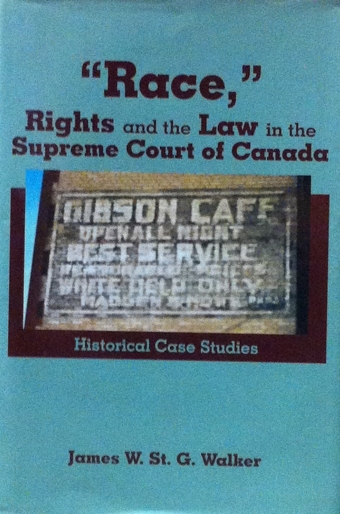
"Race", Rights and the Law in the Supreme Court of Canada: Historical Case Studies
 1997
1997 
by James St. G. Walker, Professor of History and Associate Chair of Graduate Studies at the University of Waterloo. Published with Wilfrid Laurier University Press, 1997.
Professor James Walker is a distinguished historian who has made a substantial contribution to understanding the role of minority groups, especially aboriginal populations and those of African ancestry, in the Canadian past. The present study is a culmination of years of thought and research in this critical area. ‘Race,’ Rights and the Law in The Supreme Court of Canada: Historical Case Studies is a superb analysis of how the Canadian judicial system dealt with four cases where “race” and “law” intersected: Quong Wing v. The King (1914); Christie v. York Corporation (1939); Noble and Wolf v. Alley (1950); and Narine-Singh v. Attorney General of Canada (1955).Professor Walker himself aptly notes that the events described in this book will “challenge many Canadians’ image of our national history and character, and the nature of our justice system.” But these events are on the whole encouraging and even inspirational, revealing how minority Canadians confronted restrictions in the past despite institutional barriers.The book also illustrates the rich possibilities of using case law to illuminate Canadian social history and the value of understanding the context of the times in interpreting court decisions. Not least impressive is how surefootedly Professor Walker, without formal legal training, has tackled and understood legal issues of great complexity and subtlety. ‘Race,’ Rights and the Law achieves new standards of legal-historical analysis in Canada. It will be of great interest to scholars of law and history and to all those concerned with building a Canadian future worthy of those who challenged racial disadvantage in the past.
Related Topics
Contents
Contents
Foreword vii
Preface ix
Acknowledgments xi
Invitation 3
Chapter 1 Orientation 12
1. “Race” and the Law 12
2. Approaching the Bench 32
3. Approaching the Past 36
Chapter 2 Quong Wing v. The King 51
1. The Legislation 51
2. The Chinese Problem 56
3. Restriction and Regulation 67
4. Litigation 72
5. Defending the Family 78
6. The Moral Crusade 83
7. Chinese Response 87
8. Quong Wing and Quong Sing 90
9. Quong Wing v. the King 100
10. Explanations 106
11. Quong Wing as Precedent 120
Chapter 3 Christie v. York Corporation 122
1. The Incident 122
2. “Jim Crow” in Canada 124
3. The Montreal Community 137
4. Issues and Initiatives 143
5. La Question de la Liberté 151
6. In the Supreme Court of Canada 158
7. Aftermath 168
8. Christie as Precedent 173
Chapter 4 Noble and Wolf v. Alley 182
1. Exclusive Clientele 182
2. Counter Attack 192
3. Principles and Policies 199
4. The Public Interest 206
5. Preparing for the Supreme Court of Canada 219
6. Noble and Wolf v. Alley 226
7. Noble and Wolf as Precedent 235
Chapter 5 Narine-Singh v. Attorney General of Canada
1. “Race” and Immigration 246
2. Restrictive Tradition 249
3. South Asian Immigration 253
4. Rehearsal: Narain Singh and Munshi Singh 257
5. West Indian Immigration 262
6. Policy Shifts, 1945-52 265
7. The Immigration Act, 1952 271
8. Campaign for Immigration Reform 274
9. The Inevitable: Harry Singh in the Ontario Courts 285
10. Anticlimax: The Supreme Court of Canada 291
11. Confirmation 296
Chapter 6 Implications 301
1. “Race” and “Race Relations” 303
2. Legal Sensibility 309
3. Historical Study 319
Afterword 324
1. Directions in Public Policy 325
2. Apprehensions 337
3. Reflections 343
Notes 345
Index 437
Reviews
This book is a major contribution to our understanding of the interaction of race and the law in the Canadian experience. It is history told with engaging detail, in a lively and comprehensive style and embodying wise and convincing reflection. John McLaren, Canadian Historical Review, Vol 80, 1999, p. 706.
The author has illuminated the historical systematic racism in Canadian law and society most effectively, and he has shattered the smug self-righteousness of many Canadians. He convincingly presents national and international contexts for Canadian legal developments...and sets out the appropriate theoretical and methodological context for this and other historical studies. In every way, this is an impressive and important book. Michael Brown, American Historical Review, Vol 104, 1999, p. 1654.
Tracey Lindberg, Labour/Le Travail, Vol 47, 2001, p. 185.
Louise Robertson, Canadian Law Libraries, Vol 26, 2001, p. 92.
Benjamin Berger, Osgoode Hall Law Journal, Vol 38, 2000, p. 519.
Edward Andrew, Journal of Canadian Studies, Vol 34, 1999, p. 184.
Rosemary Cairns-Way, National Judicial Institute Bulletin/Institut national de la magistrature Bulletin, Vol 12, 1999, p. 3(2).
Kerry Rittich, University of Toronto Quarterly, Vol 68, Winter 1998/1999, p. 377.
Jim Hornby, Dalhousie Review, Vol 77, 1997, p. 299.