
 Logout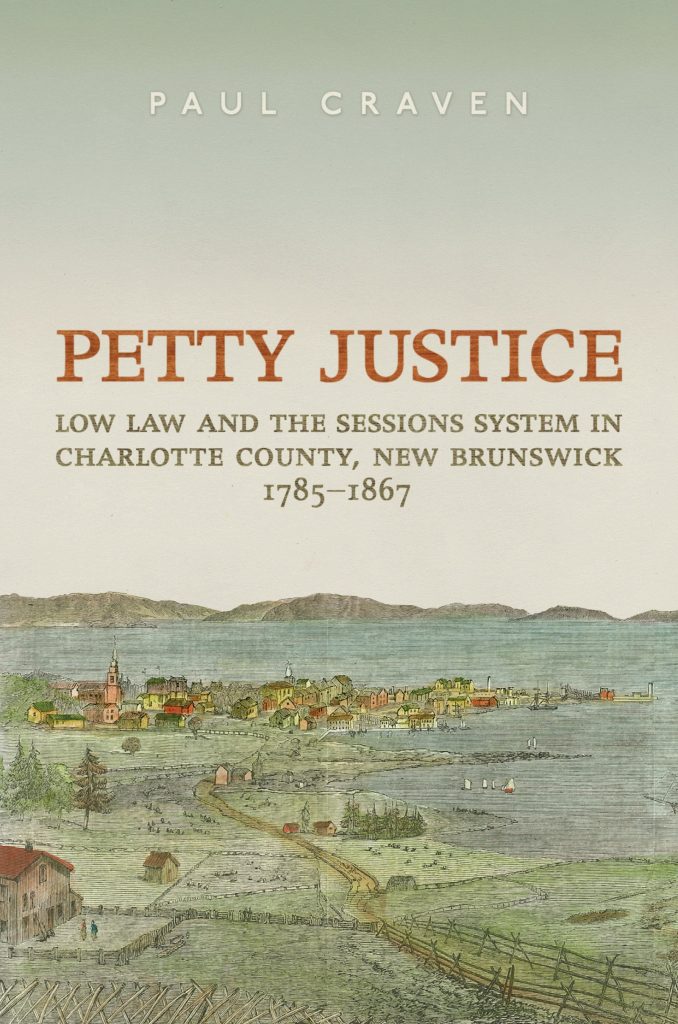
Petty Justice: Low Law and the Sessions System in Charlotte County, New Brunswick, 1785-1867
 2014
2014 
by Paul Craven, Professor, Social Science Division, York University, published by the University of Toronto Press, 2014.
Local administration and law enforcement in pre-Confederation Canada was largely done through a coterie of appointed officials, most notably the justices of the peace, but also including constables, parish officers, overseers of the poor, and the like. Justices and grand juries met at sessions courts to make local regulations, and justices and other officials enforced those regulations as well as the common law and provincial statutes. Justices exercised a minor civil jurisdiction and shared petty criminal jurisdiction with the sessions court. This system, inherited from Britain, has not previously been closely examined for Canada, and Paul Craven’s masterful study of its operation and decline is thus a landmark in our legal history. In a remarkably deeply researched study of one county, Craven explains how the system worked, who used it, and how private and public roles and interests overlapped and interacted.
REVIEWS:
‘This detailed and thoughtful account of the administration of justice in Charlotte County, New Brunswick, before Confederation offers insights on how ‘low law’ – appointed amateur official and the general sessions of the peace – worked at the ground level…. Craven sheds light on the grey areas in which justice … was pursued. .. In combining biography with thematic analysis, Craven makes what could have been a dry-as-dust legal history a highly entertaining treasure trove for anyone interested in … social history’. Margaret Conrad, University of Toronto Quarterly, Vol 85, 2016, pp. 565-566.
Contents
CONTENTS
List of Figures vii
List of Tables viii
Foreword xi
Preface xiii
1 Introduction: High law, low law, not law 1
Part I Petty justices
2 The trials of David Owen, 1787-1803 39
3 High noon at Campobello: St Andrews and the islands in the 1820s 81
4 The empire strikes back: Executive action, 1824-32 113
Part II Doing substantial justice
5 In the woods: Low law and the Crown Land Office 149
6 ‘Unconnected with mercantile pursuits’: The justice business, 1840-1 191
7 Hatheway’s civil docket, 1847-67 225
8 Hatheway’s crown docket, 1841-67 277
Part III The sessions system and its enemies
9 Called to account: Justices, assemblymen, and ratepayers 323
10 Three ships: Poverty, paternalism, and politics at mid-century 361
11 The temperance magistrates: Licence and prohibition 415
12 The sessions system in decline 459
Appendices 487
Bibliography 516
Index of Names 527
Topical Index 535
Reviews
Lindsay Campbell, Acadiensis, Vol 44, 2015, pp. 149-160