
 Logout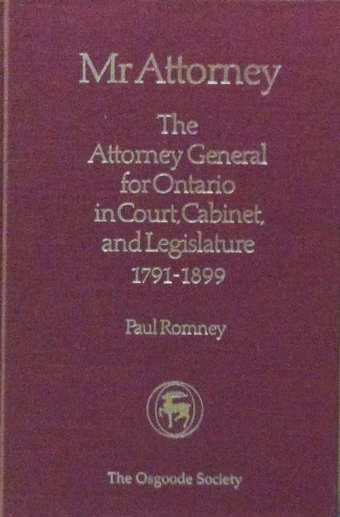
Mr. Attorney: The Attorney General for Ontario in Court, Cabinet and Legislature, 1791-1899
 1986
1986 
by Paul Romney. Published with the University of Toronto Press, 1986.
Mr. Attorney is a major exercise in revisionist historiography. Based on extensive research in often obscure sources, it offers an account of the office of Attorney General which reinterprets several key themes of nineteenth-century constitutional and political history. Paul Romney argues that grievances involving the Attorney General and the administration of justice were central to the rise of organized political opposition before the Rebellion of 1837 and remained important into the 1850s. Placing legal and administrative issues in their social context, Romney undertakes the first serious examination of developments of crucial importance to the administration of justice, such as the campaign for the Felons Counsel Act of 1836, the origin of the county attorney, the history of trial by jury, and the controversy over the idea of a provincial police force. Romney presents his arguments in sparkling and often combative prose.This important book has excited much controversy among historians and lawyers. Its theses increasingly command general assent.
Related Topics
Contents
Contents
FOREWORD ix
PREFACE xi
Introduction 3
1 King Lear’s Fool 14
2 The Rewards of Office 36
3 A Question of Confidence 62
4 Responsibility and Independence 158
5 The Public Peace 201
6 In Right of Ontario 240
7 Ministers of Justice 282
Conclusion: Law and the Constitution 313
APPENDIX 333
BIBLIOGRAPHICAL NOTE 337
NOTES 341
INDEX 383
Reviews
Romney's study raises some vitally important issues that ought to be at the center of debate among legal historians. This well-written and stimulating book should play an important role in ensuring the centrality of those questions. James Snell, American Historical Review, vol 93, 1988, p. 259.
Mr. Romney's book demonstrates something of what close study of law, law officers and legal procedures can achieve in understanding better how a political community came into being in the wilderness, and developed the form and modus operandi we know today. H.S. Ferns, English Historical Review, vol 105, 1990, p. 222.
Colin Read, Acadiensis, Vol 19, 1990, p. 176.
Carol Wilton-Siegel, Canadian Historical Review, Vol 69, 1989, p. 396.
H.T. Holman, Archivaria, Winter 1987/1988, p. 113.
David Howes, Ontario History, Vol 79, 1987, p. 350.
Mary Stokes, American Review of Canadian Studies, Vol 17, 1987, p. 350.
Douglas Peppiatt, The Toronto Star, 28 March 1987, p. M4.