Logout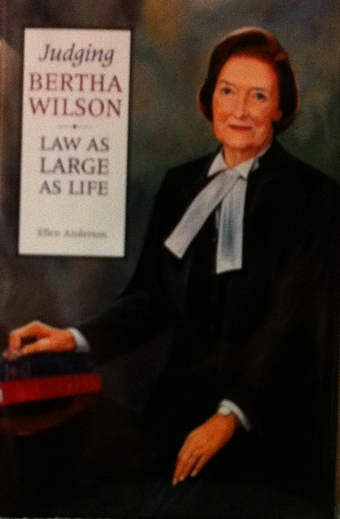
Judging Bertha Wilson: Law As Large As Life
 2001
2001 by Ellen Anderson, Lawyer, Barrie, Ontario. Published with the University of Toronto Press, 2001.
Bertha Wilson is the first woman to be appointed to the Ontario Court of Appeal. She is the first woman to be appointed to the Supreme Court of Canada at that critical moment when the Charter was entrenched. Nevertheless, Bertha Wilson has never considered herself to be a feminist. But neither has she ever backed off from controversy, a reputation sustained in this authorized intellectual biography. The early Charter years were turbulent times. Wilson is remarkably frank about the many issues affecting judicial decision-making as the Court struggled with Charter interpretation. In this intriguing biography, we come to understand what drove the sense of duty impelling Wilson to take on so extraordinary a burden of dissents and concurrences.
The Bertha Wilson story begins with her Scottish values and experiences and it concludes with her gruelling years on the Royal Commission on Aboriginal Peoples. Before judging, Wilson said, a judge must “enter the skin.” Seen from an intimate and even affectionate perspective, there can be no doubt Bertha Wilson is one judge who really did make a difference.
Related Topics
Contents
Contents
FOREWORD
The Osgoode Society for Canadian Legal History ix
FOREWORD
Bertha Wilson xi
PREFACE xiii
ACKNOWLEDGMENTS xix
PART ONE
The Preparatory Years: Life before the Bench
1 Growing Up: Daughter, Sister, and Student 3
Family Life 4
Church and School 8
University Studies: War and Romance 12
2 The Clergyman’s Wife 19
Macduff: An Education for Living 20
Conscience and Compromise 24
On the Boundary: Immigration to Canada 27
Ottawa on Her Own 31
3 Diligence at Dalhousie 35
Sopping It Up: The Law Student as Sponge 36
Classroom and Curriculum 39
Social Life and Study Group 42
Graduation and Articles 48
4 The Osler Innovations 51
Establishing a Research Practice 52
From Family Firm to Corporate Culture 57
Developing Philanthropy: A Conservative Socialist at Work 62
Courtroom Strategy: Texas Gulf Sulphur 65
The Conscience of the Firm 69
Public Commitments, Private Life 72
PART TWO
On the Bench: The Ontario Court of Appeal and
the Supreme Court of Canada
5 The Ontario Court of Appeal 83
Appointment to the Court of Appeal 85
On-the-Job Training: Making a Place 86
Criminal Law: A Provocative Dissent 91
Commercial Law: Consistency and Contextuality 94
All in the Family 99
The Human Rights Cases 118
The Supreme Sacrifice 124
6 A Canadian Philosophy of Judicial Analysis 132
Origins and Sources: The Personal and the Public 132
Principled Contextuality 136
The Charter: Principled Contextuality, National Feeling 141
7 The Supreme Court of Canada 149
Inside the Court 150
8 Diversity at the Margins 167
Multiculturalism: Theories of Human Rights 170
Adverse Effects and Undue Hardship 171
Immigration: Liberty and Security of the Person 175
Freedom of Religion 178
Wrongful Dismissal 179
Equality, Citizenship, and Analogous Grounds 182
Mandatory Retirement 183
Minority Language Rights 185
Aboriginal Law Developments 188
9 Beyond Family Law: Justice for Women and Children 197
Concepts of the Family 202
Spousal Support Revisited 204
The Best Interests of the Child 213
Violence against Women and Children 218
Prostitution and Freedom of Expression 223
Abortion, Privacy, and the Ambivalence of Choice 227
10 Getting Down to Business: Law and Economics
in the Marketplace 235
The Context of Business 235
Leave to Appeal 239
Tort, Contract, and Trust Law 244
A ‘Taking’ of Property: Constructive Trust 249
Taxing Business Decisions 251
Business Entities, Corporate Control, and Legal Subjects 252
Labouring over Labour Relations 256
Guaranteed Rights for Corporations 262
Ethics and Economics: Wilson’s Business Context 268
11 Contextual Proceduralism 271
Judicial Activism, Judicial Obligation 271
Procedural Convergences, Substantive Effects 279
Intervention and Extrinsic Evidence 292
Old Dogs, New Tricks 299
The Administrative Law Paradox 303
International Law: Sovereignty, Reciprocity, and Comity 310
12 Outside the Court 317
Multiple Dimensions: The Extra-Judicial Duties 317
Time to Move On 325
PART THREE
Life after Judging
13 The Gender Equality Study 335
Finding the Funding: Costly Consultations 337
Billable Hour Quotas and the Duty to Accommodate 343
Women in the Judiciary 346
14 The Royal Commission on Aboriginal Peoples 352
Getting under Way: Mandate and Methodology 354
Hearing Stories, Seeking Solutions 357
Staffing the Commission: The Interim Reports 360
Writing the Final Report 368
Response to the Report 372
15 Portrait of a Judge 379
ADJUNCT INTERVIEWS 385
ARCHIVAL RESOURCES 393
NOTES 395
SELECT BIBLIOGRAPHY 451
INDEX 455
Awards
- Ontario Historical Society's Alison Prentice Award (2004)
Reviews
Ellen Anderson's engaging book on Justice Bertha Wilson is timely and records a life filled with firsts. ... Anderson's book is inspirational in showing what can be achieved when a person possessing innate ability is exposed to a good education. It is a female Horatio Alger story but instead of rags to riches, the transformation is from local parish influence in Scotland to significant national influence in Canada. ... We should all be very grateful to Anderson for telling the Wilson story skillfully with insight, passion and elegance. Not only does the story need to be told but it needs to be read, not just by lawyers, law students and students of politics but by all citizens who wish to be well informed about the third branch of government, the judiciary, which since the Charter has a much enhanced role to play. Gordon Bale, Supreme Court Law Review, vol 18, 2002
An exceptional book about an exceptional judge...one of the best biographies I have ever read. Chief Justice Antonio Lamer, Ottawa Law Review, vol 22, 2002 , p.483.
Anderson's book does not simply introduce us to the life of an important judge, though it does do that. It also encourages us to live similarly in the law. It encourages an adoption of Wilson's concerns with a multiplicity of legal subjects .... Anderson offers both a book and a challenge worth picking up. Rebecca Johnson, Canadian Bar Review, Vol 81, 2002, p. 483.
Constance Backhouse, Labour/Le Travail, No 67, 2003, p. 295.
Clare McGlynn, Feminist Legal Studies, Vol 11, 2003, p. 307.
Paul Sheridan, University of Toronto Faculty of Law Review, Vol 61, 2003, p. 133.
Thomas M.J. Batemen, Law & Politics Book Review, Vol 12, 2002, p. 90.
Andrea Cambridge, Canadian Law Libraries, Vol 27, 2002, p. 236.
Jodi McNaughton, Saskatchewan Law Review, Vol 65, 2002, p. 589.
Jonathan Swainger, Canadian Historical Review, Vol 83, 2002, p. 591.
Michael J. O'Keefe, The Advocate, Vol 60, 2002, p.765.
Christopher Moore, Law Times, Vol 19, 2001, p. 7.