Logout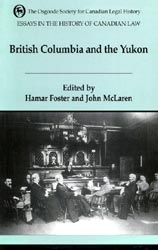
Essays in the History of Canadian Law, Volume VI: British Columbia and the Yukon
 1995
1995 
edited by Hamar Foster and John Mclaren, Faculty of Law, University of Victoria. Published with the University of Toronto Press, 1995.
This sixth volume in the distinguished series on the history of Canadian law turns to the central theme in the history of British Columbia and the Yukon – law and order. In the early days of British sovereignty, the frenzied activity of the fur trade and the gold rush, along with clashes between settlers and Natives, made law enforcement a difficult business. Later, although law and order were more firmly established, tensions continued between the dominant populations committed to the practice and rhetoric of British justice and those groups owing allegiance to other value systems (such as Native peoples, Asian immigrants, and Doukhobors) or those resisting authority (criminals and the criminally insane). These essays look at key social, economic, and political issues of the times and show how they influenced the developing legal system.The essays cover a wide range of topics, and explore the human as well as the legal dimensions of their subjects, relating specific cases to broader theory. They demonstrate that English law has been flexible enough to accommodate diversity and is, therefore, pragmatic. The volume also shows how geography, demography, politics, economics, and military considerations have had an impact on the shape of our legal culture. The introduction by John McLaren and Hamar Foster pulls together the many regional themes to provide a clear overview of the legal complexities of the period.
Related Topics
Contents
Contents
Foreword xi
Acknowledgments xiii
Contributors xv
INTRODUCTION
1 Hard Choices and Sharp Edges: The Legal History of
British Columbia and the Yukon
JOHN McLAREN and HAMAR F OSTER 3
PART I: ABORIGINAL PEOPLE AND THE LAW
2 Letting Go the Bone: The Idea of Indian Title in British Columbia,
1849-1927
HAMAR FOSTER 28 28
3 ‘Where Is the Justice, Mr Mills?’: A Case Study of R. v. Nantuck
ALAN GROVE 87
4 Tonto’s Due: Law, Culture, and Colonization in British Columbia
TINA LOO 128
PART II: VICE, CRIME, AND P OLICING
5 Swift Justice and the Decline of the Criminal Trial Jury:
The Dynamics of Law and Authority in Victoria, BC, 1858-1905
NANCY PARKER 171
6 A Distant Edge of Authority: Capital Punishment and the
Prerogative of Mercy in British Columbia, 1872-1880
JONATHAN SWAINGER 204
7 Vancouver Vice: The Police and the Negotiation of Morality,
1904-1935
GREG MARQUIS 242
8 The Making of Criminal Insanity in British Columbia: Granby
Farrant and the Provincial Mental Home, Colquitz, 1919-1933
ROBERT MENZIES 274
PART III: RELIGION AND EDUCATION
9 Judgments of Solomon: Law, Doctrine, and the Cridge
Controversy of 1872-1874
RUSS BROWN 313
10 Creating ‘Slaves of Satan’ or ‘New Canadians’?: The Law,
Education, and the Socialization of Doukhobor Children,
1911-1935
JOHN McLAREN 352
PART IV: LABOUR AND SOCIAL WELFARE
11 After Union Colliery: Law, Race, and Class in the Coalmines of
British Columbia
ROSS LAMBERTSON 386
12 For God, Country, and the Public Purse: ‘Liberal’ Politics and
the Campaign for Family Courts in British Columbia, 1939-1945
DOROTHY E. CHUNN 423
PART V: THE LEGAL PROFESSION
13 Fighting Spirits: The Yukon Legal Profession, 1898-1912
BURT HARRIS 457
14 Exclusionary Tactics: The History of Women and Visible
Minorities in the Legal Profession in British Columbia
JOAN BROCKMAN 508
Index 563
Publications of The Osgoode Society for Canadian Legal History 584
Reviews
A splendid addition to the all-too-sparse literature of British Columbia and Yukon legal history.... This is a book to order quickly. Martin Taylor, The Advocate, vol 54, 1996 , p. 453.
The essays are conveniently broken down into chapters dealing with aboriginal issues, crime and policing, religion and education, labour and social welfare, and the legal profession itself. All of these reflect the recurrence of conflicts between aboriginal and dissident groups and the law, a fact which will make this book useful as a reference not only for historical scholars but also for those dealing with similar problems today, particularly in the area of aboriginal justice and land-claims issues. C. D. Ram, International and Comparative Law Quarterly, vol 46, 1997, p. 496.
Louis A. Knafla, American Journal of Legal History, Vol 42, 1998, p. 461.
C.D. Ram, International and Comparative Law Quarterly, Vol 46, 1997, p. 496.
John A. Cherrington, B.C. Historical News, Vol 30, 1997, p. 37.
Ian Holloway, Australian Journal of Legal History, Vol 2, 1996, p. 223.
Anonymous, Law & Social Inquiry, Vol 21, 1996, p. 493.
Reviews have also appeared in a variety of other media.