Logout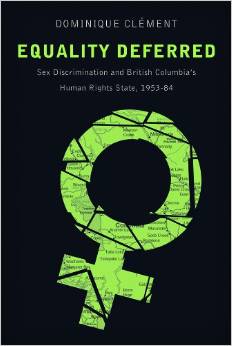
Equality Deferred: Sex Discrimination and British Columbia’s Human Rights State, 1953-84
 2014
2014 
by Dominique Clément, Professor of Sociology, University of Alberta, published by the University of British Columbia Press. 2014.
One of the most profound changes to our law in the second half of the twentieth century was what is often termed the ‘rights revolution’. The same period also saw the rise of a plethora of administrative agencies to administer law and policy in many areas. Professor Clement’s pioneering study combines these two phenomena, providing a history of the origins and operation of human rights law and the human rights commission in British Columbia. It focusses particularly on sex discrimination, and documents the political debates surrounding human rights law, analyses the role of social movements in developin1g the law, and discusses the working of the tribunals and human rights investigators who put the law into practice.
Contents
CONTENTS
List of Illustrations ix
Foreword xi
Preface xiii
Acknowledgments xvii
Additional Resources xix
Introduction 3
1 Sex Discrimination in Canadian Law 22
2 “No Jews or Dogs Allowed”: Anti-Discrimination Law 46
3 Gender and Canada’s Human Rights State 66
4 Women and Anti-Discrimination Law in British Columbia, 1953-69 86
5 Jack Sherlock and the Failed Human Rights Act, 1969-73 94
6 Kathleen Ruff and the Human Rights Code, 1973-79 109
7 Struggling to Innovate, 1979-83 134
8 Making New Law under the Human Rights Code 157
9 The Politics of (Undermining) Human Rights: The Human Rights Act, 1983-84 169
Conclusion 197
Notes 217
Bibliography 270
Index 284
Reviews
Pearl Eliadis, Canadian Journal of Law and Society, Vol, 30, 2015, pp. 491-493