Logout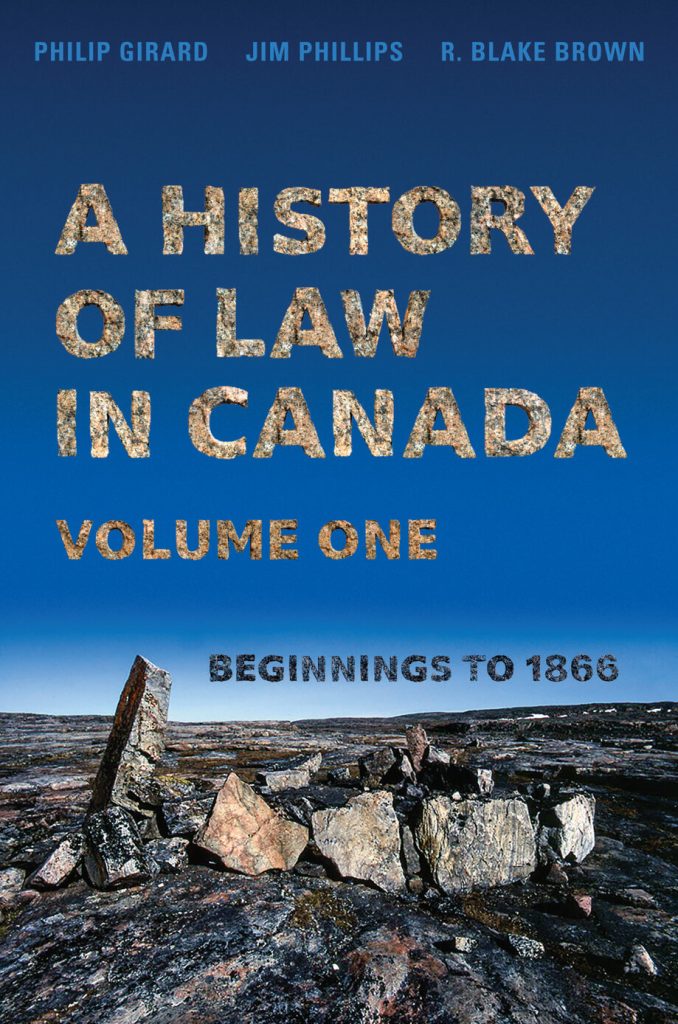
 2018 Member Selection
A History of Law in Canada Volume 1: Beginnings to 1866
 2018
2018 
By Philip Girard, Jim Phillips, and Blake Brown. Published by the University of Toronto Press.
This book, the first of 2 volumes, presents the history of law in what is now Canada, from the first European contacts with northern North America in the very early sixteenth century to immediately before Confederation. Divided into four parts, the book first looks at the roots of Canada’s three legal traditions, Indigenous, French and English, in North America, France and England. Part 2 examines the period down to 1701 and the signing of the treaty known as the Great Peace of Montreal in 1701, during which New France was established. Part 3 deals with the eighteenth century – Anglo-French conflict, New France until 1760, the establishment and growth of English colonies of settlement, and, throughout, relations with indigenous peoples and governance of indigenous nations. Part 4 is devoted to the British North American period, after 1815. Indigenous people are central of the narrative throughout, including after 1815 when their influence waned as their land base was largely lost in central and eastern Canada. Included in Part 4 are the Red River settlement and early British Columbia. Although the background to this history are the well-known major political, military, social and economic transformations of this part of North America, the book is principally a legal history set against and integrated with that background. Court systems, the judiciary, the legal professions, are dealt with in every period and for each of the legal traditions, and the areas of law covered include criminal, family, constitutional, commercial, land, succession, and civil and criminal procedure. This volume combines the remarkable flowering of scholarship on Canadian legal history, so much of it fostered and published by the Osgoode Society over 35 years, and much new research.
AWARDS
Honourable Mention – Canadian Law and Society Association Book Prize 2019
A History of Law in Canada Volume I was awarded an honourable mention for the W. Wesley Pue Book Prize given by the Canadian Law and Society Association in 2019. The citation for the award reads as follows: A History of Law in Canada, Volume One is a monumental and masterful work. It fills a gap in Canadian scholarship by providing a comprehensive, well-written and informative account of the history of law in Canada. Its 900 pages of text and footnotes reflect an astonishing range of knowledge. It breaks new ground in its sweep and scale, and its interweaving of the history of the three pillars of Canadian law: common law, civil law and Indigenous legal orders. It will be a classic for many years, a guide and inspiration to Canadian legal historians for generations to come.
REVIEWS OF A HISTORY OF LAW IN CANADA VOL I : BEGINNINGS TO 1866
The authors set themselves a daunting task in this admirable book, the initial offering in a longer ambitious project on the history of law in Canada. …. Their success is measured in an engaging and accessible argument that raises important questions about the colonial legacies that continue to shape and inform contemporary debate, policy, and interpretation of the law in Canada, especially at it relates to the country’s First Nations peoples…. The book offers two broad interpretative themes. The first is legal pluralism, which is read and applied in multiple and nuanced ways in the work. First, the authors construe the French and English legal worlds as pluralistic, given that both combined royal authority, traditional prescription, and customary norms. However, because our understanding of First Nations’ legal systems tends to be particular rather than general, it is difficult to state with certainty that their pre-contact legal systems functioned in a fashion that would have aligned with a European, let alone a contemporary, definition of legal pluralism. What can be said is that in their engagement with the European newcomers, specific North American First Nation communities certainly embraced a more Western style of legal pluralism…. The second theme is liberty and order. Here too is a fine balance. From a European perspective, much of early North American social, political, economic, and legal history turned on questions of liberty and order. As the book demonstrates, within the various nations, as well as among those communities, absolutes entailing liberty or order were mercurial. How liberty might function meant something different for First Nations individuals, community leaders, habitants, French merchants, traders, and church officials. ….. Like legal pluralism, the interpretative theme of liberty and order contributed to challenging debates about the meanings of law and law reform as the British North American colonies became increasingly confident in the middle decades of the nineteenth century….. Authors Philip Girard, Jim Phillips, and R. Blake Brown have crafted a thought-provoking volume that should be required reading for all Canadian legal historians, and advised reading for anyone interested in northern North American legal history. Further, given its relevance to a variety of fields and subdisciplines, the book deserves the attention of any North American historian drawn to First Nations, colonial, social, political, or economic history. The book is well worth sustained attention. Jonathan Swainger, Law and History Review, Vol 38, 2020 , pp. 287-290
A History of Law in Canada … is a very ambitious undertaking….The authors begin their project with a general introduction to the idea of legal pluralism and the foundations of the three legal traditions that are the focus of their study. These introductory chapters serve as an excellent primer and provide a firm foundation on which the balance of the volume rests. They will be especially valuable for readers unfamiliar with legal history. The chapters that follow outline the law and its development in each of the three traditions over a period of roughly three and a half centuries, from the time of the arrival of Europeans in the lands that became Canada until the 1860s. The range of subjects addressed in these chapters is enormous, including law-making, the development and evolution of institutions, criminal law, family law, law relating to the economy, gender and race, and more besides….
The authors make a number of original contributions to the study of the history of law in Canada. The most obvious of these is the identification of three periods into which the legal history of the pre-Confederation era can be usefully divided: 1500–1701, 1701–1815, and 1815 to the 1860s. The reasons for the departure from better known watershed moments – Britain’s conquest of New France in 1763, for example – are persuasively argued and reflect the fact that development of the law has not always moved in lockstep with political, economic, or other aspects of Canadian history. … The identification of important themes within Canadian legal history and the critical surveying of the published literature relating to these themes is also a significant and valuable contribution, especially for readers unfamiliar with that substantial body of work. .. In sum, History of Law in Canada achieves the goals of its authors admirably. It contains a wealth of information on the three legal traditions of early Canada and is written in a style that is clear enough to be accessible to a wide range of readers and with a completeness and rigour that should satisfy scholars. Ken Leyton-Brown, Canadian Historical Review, Vol 101, 2020.
REVIEWS OF A HISTORY OF LAW IN CANADA VOL I: BEGINNIGS TO 1866 HAVE ALSO APPEARED IN:
Shelley Gavigan, Osgoode Hall Law Journal, Vol 58, 2021, pp. 719-725.
Philip Buckner, British Journal of Canadian Studies, Vol 32, 2019-2020, p. 154.
James Muir, Acadiensis, Vol 49, 2020, pp. 208-22.1
Jamie Benidickson, Canadian Journal of Law and Society, Vol 36, 2021, pp. 536-538.
Contents
Foreword / xiii
Acknowledgments / xv
PART ONE: INTRODUCTION
1. INTRODUCTION / 3
Legal Pluralism in Empires and Nations / 5
Indigenous Law in History: Methodological and Theoretical Issues / 9
Liberty and Order / 13
Overview: Historiography and Periodization / 17
2. ROOTS: INDIGENOUS LEGAL TRADITIONS / 26
Indigenous Legal Traditions: Basic Features / 26
Indigenous Law: Process and Content / 30
3. ROOTS: FRENCH LEGAL TRADITIONS / 42
The Roman Legacy / 42
The Emergence of the French Customs / 44
Institutional Development / 46
Legal Education, the Legal Professions, and the Role of Doctrine / 53
The Constitution / 56
4. ROOTS: BRITISH LEGAL TRADITIONS / 60
The Anglo-Saxon Legacy / 60
Institutional Development after 1066 and the Emergence of the Common Law / 62
Legal Education, the Legal Professions, and the Role of Doctrine / 70
The Constitution / 73
PART TWO: EUROPEAN CHARTERED ENTERPRISE, NEW FRANCE, AND THE ENCOUNTER WITH INDIGENOUS LAW, 1500–1701
5. EARLY CONTACTS, EARLY CHARTERS / 83
6. LAW AND GOVERNANCE IN THE FRENCH POSSESSIONS: PUBLIC LAW AND THE GROWTH OF INSTITUTIONS / 92
From Seigneurial Fief to Royal Colony: Institutional Development / 94
Seigneurial Law / 103
Notaries / 112
Civil Procedure / 116
Criminal Procedure / 120
7. LAW AND GOVERNANCE IN THE ENGLISH POSSESSIONS / 129
Newfoundland: From Company to Proprietorship to Anti-Colony / 129
Rupert’s Land: The Emergence of a Company-State / 135
8. THE INTERFACE OF EUROPEAN AND INDIGENOUS LAW / 139
9. FRENCH PRIVATE LAW / 150
The French Customs / 150
The Law of Marriage and the Family / 152
The Law of Family Property: Matrimonial Regimes and Succession / 158
The Law of Obligations / 164
10. THE EARLY MODERN LEGACY / 167
PART THREE: THE LONG EIGHTEENTH CENTURY, 1701–1815
11. CONSTITUTIONAL LAW IN THE LONG EIGHTEENTH CENTURY / 175
The Politico-Military Context / 175
The Legal Contexts / 185
Slavery, Race, and the Constitution / 202
12. NEW FRANCE/QUEBEC/LOWER CANADA: POLITICAL INSTITUTIONS, COURTS, AND RELATIONS WITH INDIGENOUS PEOPLES / 216
New France before 1760 / 216
Quebec/Lower Canada after 1760 / 218
Relations with Indigenous Peoples / 224
13. THE BRITISH COLONIES OF SETTLEMENT: POLITICAL INSTITUTIONS, COURTS, AND RELATIONS WITH INDIGENOUS PEOPLES / 227
Nova Scotia, New Brunswick, and Prince Edward Island / 227
Upper Canada / 245
14. THE BRITISH COMMERCIAL TERRITORIES: NEWFOUNDLAND AND RUPERT’S LAND / 252
Justice beyond the Settlement Frontier: The Challenge of Remoteness / 252
Newfoundland / 256
Rupert’s Land / 260
15. THE LEGAL PROFESSIONS / 267
16. CRIMINAL LAW AND CRIMINAL JUSTICE / 275
English Criminal Law in the Eighteenth Century / 276
The Reception of English Criminal Law in British North America / 278
Punishment in Practice / 280
Bringing an Offender to Court: Policing and Prosecution / 287
The Criminal Courts: Pretrial Procedures / 291
The Criminal Trial / 293
17. INDIGENOUS LAW / 303
18. PRIVATE LAW: THE CIVIL LAW / 320
The Civil Law to 1760: Canada, Acadia, Louisbourg / 320
The Civil Law after 1760: The Emergence of a Mixed Legal Tradition / 324
19. Private Law: The Common Law / 338
20. The Early Modern Legacy / 264
PART FOUR: BRITISH NORTH AMERICA, 1815–1860s
21. LAW IN BRITISH NORTH AMERICA, 1815–1866: INTRODUCTION / 373
22. COURT SYSTEMS AND JUDICIAL PERSONNEL / 379
The Development of a British North American Judiciary / 380
Separation of Powers, Appointment and Removal of Judges, and Judicial Remuneration / 384
Circuit Systems: Bringing the Centre to the Hinterland / 390
Chancery Courts / 392
The Rise of Inferior Tribunals / 397
New Superior Courts and Professional Courts of Appeal in the Canadas / 404
Procedural Reform / 406
23. SOURCES OF LAW AND LAW REFORM / 411
Sources of Law in Common Law Jurisdictions / 413
Sources of Law: The Civil Law / 419
Sources of Law: The Civil Code of Lower Canada / 425
Statutes: Making and Remaking Local Laws and Societies / 439
24. INDIGENOUS LAW IN BRITISH NORTH AMERICA / 447
Indigenous Governance in an Age of Settler Political Reform / 452
Legal Personality and Indigenous Agency / 455
Land Use and Citizenship / 460
25. THE LEGAL PROFESSIONS / 466
Entry and Governance / 467
The Business of Lawyering / 473
The Emergence of University Legal Education / 476
Legal Literature / 480
Law Reporting / 484
26. CONSTITUTIONAL DEVELOPMENTS I: EUROPEAN-INDIGENOUS RELATIONS, THE OLD COLONIAL SYSTEM, AND THE REBELLIONS, 1815–CA 1839 / 488
Indigenous Peoples, Treaties, and the Constitution in Eastern British North America / 489
The Settler Constitution: Executives, Councils, and Assemblies / 495
Rebellion and Repression in the Canadas / 507
27. CONSTITUTIONAL DEVELOPMENTS II: THE ACT OF UNION, RESPONSIBLE GOVERNMENT, AND THE ORIGINS OF ACCULTURATION POLICY, CA 1840–1866 / 515
The Settler Constitution after the Rebellions: The Union of the Canadas and Responsible Government / 516
The Settler Constitutions and Responsible Government / 524
Indigenous Peoples and the ‘Civilizing Mission’ / 531
Settlement and Colonization in the West / 537
28. CRIMINAL JUSTICE I: CRIMINAL LAW, PUNISHMENT, AND POLICING / 543
The Age of Reform: The Demise of Capital and Corporal Punishment / 544
Dissatisfaction with Physical Punishments / 550
The Search for Penal Reform and the Rise of the Penitentiary / 554
Policing / 560
29. CRIMINAL JUSTICE II: THE CRIMINAL TRIAL / 560
The Criminal Process: Judges, Juries, and Procedure / 565
Prosecution by Counsel for the Crown / 566
Defence Counsel before the Mid-1830s / 572
The Prisoners’ Counsel Acts and Their Effect / 577
30. LAND LAW AND POLICY: TITLES, TENURE, SQUATTERS, INDIGENOUS DISPOSSESSION, AND THE RIGHTS AND OBLIGATIONS OF OWNERSHIP / 587
Upper Canada: Clergy Reserves and Aliens’ Titles / 588
Lower Canada: Competing Land Law Systems and Seigneuralism / 591
Prince Edward Island: Landlordism / 596
Land Titles and Squatters in Nova Scotia and New Brunswick / 600
Newfoundland: The Formalization of Possessory Title / 606
Indigenous Peoples’ Continued Dispossession / 608
The Rights and Obligations of Land Ownership / 614
31. LAW AND THE ECONOMY I: COMMON LAW, STATUTES, AND THE EMERGENCE OF THE CORPORATION / 618
Judges, Private Law, and the Economy / 619
Colonial Statutes and the Market / 626
The Emergence and Growth of Corporations to 1850 / 628
The 1850s and 1860s: Corporate Growth and Sectoral Incorporation / 636
Limited Liability and the Morality of the Corporation / 640
32. LAW AND THE ECONOMY II: DEBTOR-CREDITOR LAW / 646
Imprisonment for Debt / 647
Bankruptcy Laws / 653
Insolvency: A Clash of Ideologies / 656
33. LESS FAVOURED BY LAW I: BLACKS AND WORKERS / 662
Blacks and the Law: Not Slaves, but Not Equal / 663
Segregated Schools / 669
Fugitive Former Slaves and Extradition / 670
Labour and the Law / 677
34. LESS FAVOURED BY LAW II: WOMEN AND THE LAW / 683
Common Law Married Women’s Property: Equity and Statutory Change / 684
The Common Law: Unmarried Parents / 691
Divorce / 694
The Civil Law: Married Women’s Property / 695
The Civil Law: Unmarried Parents / 699
35. LAW AND LEGAL INSTITUTIONS ON THE EVE OF CONFEDERATION: THE BRITISH NORTH AMERICAN LEGACY / 702
Abbreviations / 707
Notes / 711
Illustration Credits / 887
Statutory and Proclamation Index / 889
Name Index / 891
Topical Index / 895
Awards
- Honorable Mention - Canadian Law and Society Association Book Prize (2019)